
EST. 2023  ·  NEW YORK

Institutional Construction Excellence

CONSERVATION  ·  PRESERVATION  ·  LEGACY

Genesis Construction Corporation delivers specialized construction services to New York’s most distinguished cultural institutions, research facilities, and mission-critical infrastructure—where technical precision, conservation protocols, and operational continuity define success.

DISCOVER
Institutional Affiliations & Professional Memberships
NTHP AAM LEED NYC LPC LOCAL 157 DC9 LOCAL 73 BCA 7×24 EXCHANGE MAYA MAAM CCAHA NPI AMERICAN FORESTS CARBON LEADERSHIP BUILDING TRANSPARENCY CCA METRO NY NTHP AAM LEED NYC LPC LOCAL 157 DC9 CCA METRO NY
01 — About

Genesis Construction Corporation

New York’s Specialized Union General Contractor for Institutional Construction, Historic Preservation & Mission-Critical Infrastructure

Genesis Construction Corporation was established in 2023 to serve New York’s institutions requiring construction expertise beyond conventional general contracting. Our leadership brings five decades of combined experience across landmark cultural renovations, mission-critical infrastructure programs, and historic preservation projects where technical precision and institutional sensitivity define success.

That depth of expertise spans the full arc of institutional complexity — from the psychrometric precision required to maintain climate-controlled collection environments, to the zero-downtime sequencing demanded by active hospital and data center operations, to the conservation craft required for landmark interiors on the National Register of Historic Places.

Headquartered in Astoria, Queens, Genesis operates as a union general contractor specializing exclusively in projects for museums, research facilities, universities, cultural institutions, and critical infrastructure clients who cannot afford disruption or compromise.

Historic Preservation & Landmark Renovation

Museum galleries, cultural landmarks, and architecturally significant structures where preservation mandates and technical complexity demand crews trained in period-appropriate craftsmanship and modern building science.

Mission-Critical Infrastructure

Data centers, research facilities, hospital systems, and utility infrastructure where zero-downtime construction protocols, phased sequencing, and operational continuity are non-negotiable requirements.

Institutional Construction

Universities, performing arts centers, libraries, and civic facilities where community impact, long-lead procurement, and stakeholder coordination require a contractor experienced with institutional decision-making culture.

Our Approach

We build with the understanding that for our clients, the building is never just a building — it is a collection, a research program, a power grid, a campus, or a neighborhood anchor. That understanding shapes how we plan, how we staff, and how we communicate throughout every project.

As a union contractor, every tradesperson on our sites brings certified training, accountability to apprenticeship standards, and the institutional knowledge that only comes from years of working on New York’s most demanding job sites.

Certifications & Affiliations

NYC Landmarks Preservation Commission  ·  LOCAL 157  ·  DC9  ·  LOCAL 73  ·  BCA  ·  7×24 Exchange  ·  MAYA  ·  MAAM  ·  CCAHA  ·  NPI  ·  American Forests  ·  Carbon Leadership Forum  ·  Building Transparency  ·  CCA Metro NY

Union Craftsmanship & Building Science

Genesis employs union tradespeople trained through multi-year apprenticeships administered by New York City building trades — carpenters, electricians, pipefitters, sheet metal workers, and specialized craft trades bringing mastery and contemporary building science expertise to every institutional project.

Our leadership integrates European and American construction methodologies, combining traditional craft mastery with rigorous contemporary project management. This dual-methodology approach reflects decades of direct experience on complex, high-stakes projects demanding absolute coordination and technical excellence — post-crisis infrastructure restoration, renovations within active cultural institutions, and environments where operational continuity is non-negotiable.

Safety programs at GCC exceed compliance standards. Certifications in Construction Safety Management, Fall Protection, and specialized NYC regulatory protocols reflect our position that safety functions as the foundation of professional integrity rather than administrative requirement. Multilingual team coordination — in English, Spanish, and Italian — ensures productive relationships with international architects, curators, and cultural institutions across every project.

Our Guiding Principles
Historic preservation construction detail Technical precision in institutional construction Operational continuity methodology
Conservation Ethics

Stewardship over speed. We build for institutions whose facilities serve missions spanning centuries, where construction quality determines whether artifacts survive for future generations.

Technical Precision

Engineering rigor applied to every scope. Building science principles guide mechanical, electrical, and structural systems serving both operational and conservation objectives.

Operational Continuity

Zero-impact construction methodology enabling occupied facility work where public programming, research activities, and mission-critical operations cannot be interrupted.

03 — Institutional Experience

Institutional Experience

Selected Projects

Five landmark projects demonstrating the depth of institutional construction expertise GCC brings to every commission. From historic landmark restoration to mission-critical infrastructure, these projects represent the caliber of work our leadership has delivered.

Projects reflect institutional construction expertise developed prior to GCC's founding in 2023.

Project imagery used for portfolio representation only. All photographs remain property of respective owners.

Image Coming Soon
01

Pier A Harbor House

Historic Landmark Restoration

Complete core and shell restoration of Lower Manhattan's oldest surviving pier. Three-phase $37M project involving underwater structural reinforcement, geothermal array installation, and meticulous preservation of historic finishes and structural systems.

$37MProject Value
3 PhaseSequencing
NYC LPCCompliant
Image Coming Soon
02

Carnegie Hall

Studio Towers Renovation

$200M transformational renovation creating a 61,000 sq ft Education Wing with 24 ensemble rooms, practice studios, and performance infrastructure upgrades — all executed while maintaining Carnegie Hall's active concert calendar.

$200MProject Value
61,000Sq Ft
ZeroShow Cancellations
Image Coming Soon
03

Fordham University — Hughes Hall

Hughes Hall Renovation

$38M adaptive reuse of a 120-year-old Bronx residence hall into the Gabelli School of Business. Complete structural replacement and exterior restoration of 50,000 sq ft of historic stonework, executed without interrupting active campus operations.

$38MProject Value
50,000Sq Ft Stonework
Image Coming Soon
04

Park Avenue Armory

Board of Officers Room

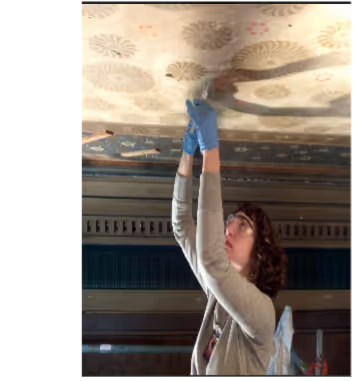
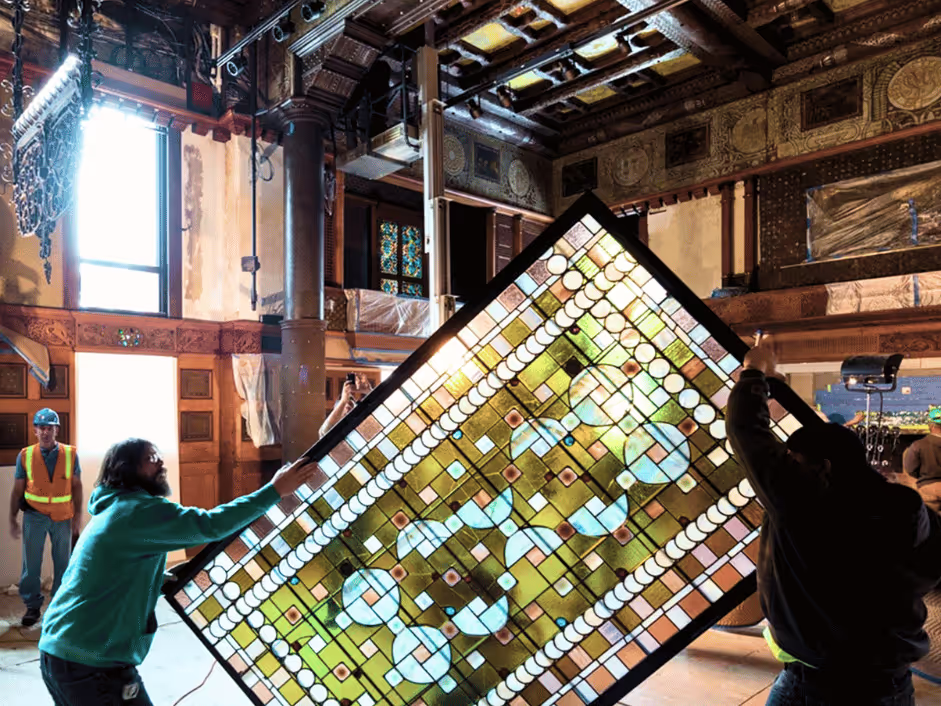
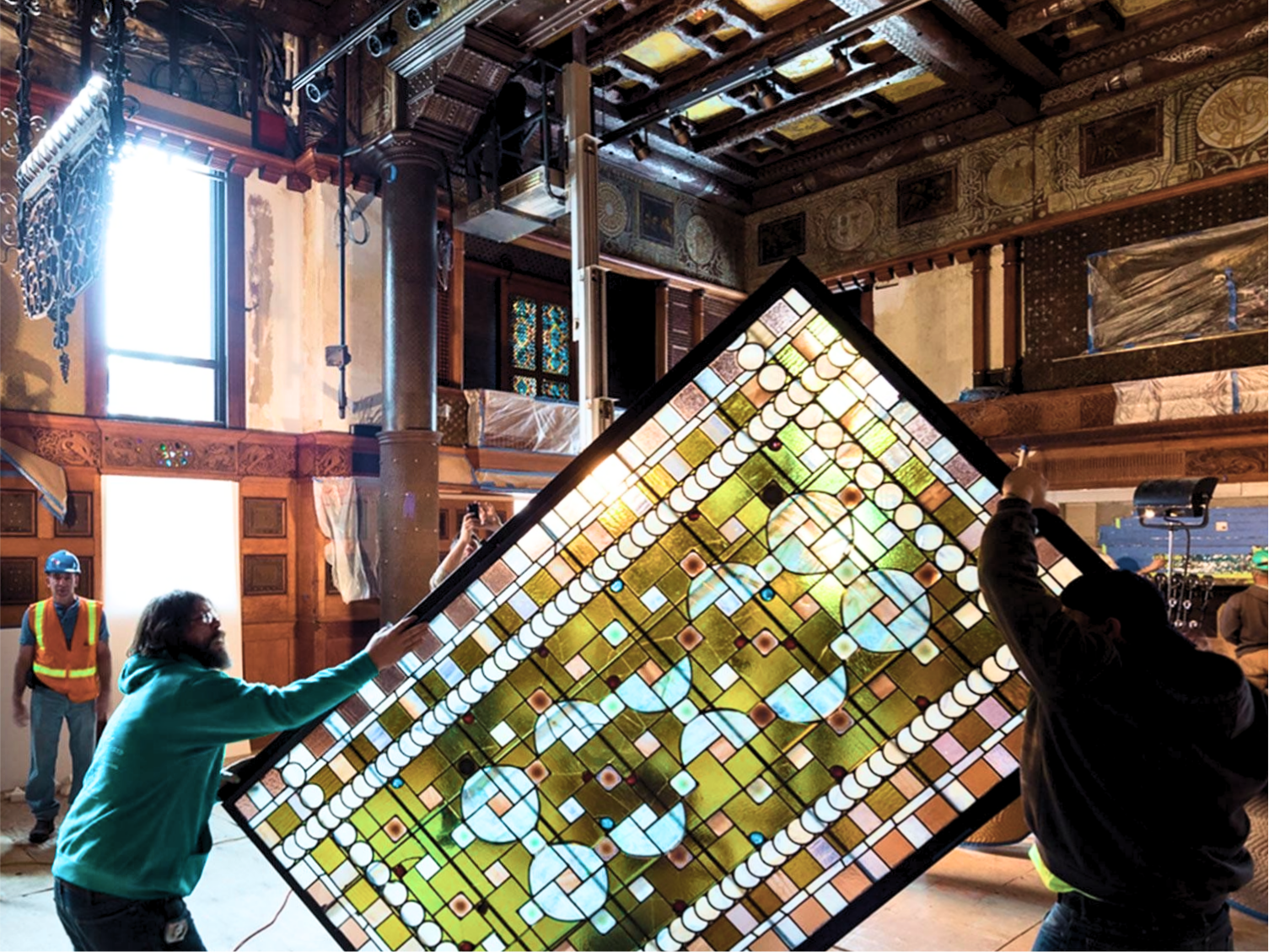
Meticulous conservation of one of America's most significant gilded-age interiors. De-layering original Herter Brothers finishes, stabilizing water-damaged plasterwork, and integrating acoustic upgrades and production lighting within historic fabric.

Gilded AgeEra Interior
SHPOStandards
Image Coming Soon
05

American Museum of Natural History

Mignone Halls of Gems and Minerals

$32M redesign of the 11,000 sq ft Mignone Halls. Custom casework for over 5,000 specimens, state-of-the-art LED lighting systems, and climate-controlled display environments maintained throughout construction in an active museum setting.

$32MProject Value
5,000+Specimens
ActiveMuseum Operations
02

Precision at Every Scale

01

Museum & Cultural Facility Construction

Cultural institutions present construction complexity that general contractors are not equipped to manage. Museum environments require environmental controls calibrated to artifact conservation standards—maintaining 40–60% relative humidity with ±2°F temperature stability while minimizing vibration transmission that could damage sensitive collections.

Environmental Control
40–60% RH, ±2°F stability
Acoustic Criteria
NC-25 for gallery spaces
Protection Systems
HEPA filtration & containment
Vibration Control
Real-time monitoring & isolation
02

Research Laboratory & Critical Infrastructure

Mission-critical facilities demand construction methodologies where operational continuity supersedes schedule acceleration. Data centers, telecommunications infrastructure, and research laboratories require Tier III/IV uptime standards—redundant mechanical systems, N+1 power distribution, and real-time environmental monitoring.

Uptime Standards
Tier III/IV compliance
Power Distribution
N+1 redundancy protocols
Temperature Control
±1°F precision cooling
Vibration Isolation
Equipment platform systems
03

Historic Preservation & Adaptive Reuse

Landmark buildings require construction approaches respecting original fabric while integrating contemporary building systems. Genesis specializes in reversible interventions—mechanical fastening over adhesive bonding, concealed infrastructure routing preserving historic finishes, and material conservation guided by preservation ethics.

Intervention Method
Reversible mechanical fastening
Material Matching
Period-appropriate sourcing
Craft Techniques
Hand-finished joinery
Code Integration
Contemporary compliance
04

Building Science & Environmental Control

Institutional construction requires engineering precision beyond standard commercial practice. Genesis applies building science principles to every mechanical, electrical, and plumbing scope—analyzing heat load calculations, psychrometric conditions, and vibration transmission to design systems serving both operational requirements and conservation objectives.

Psychrometric Analysis
Environmental modeling
Structural Engineering
Load path documentation
Acoustic Performance
NC ratings achievement
Commissioning
Functional validation testing
04

Built for Tomorrow’s Heritage

“The building dictates the intervention, not the contractor’s preference.”

GCC Design Philosophy

01 — Principle

Construction as Conservation Practice

Heritage buildings fail when contractors treat construction as the objective rather than conservation as the discipline. GCC treats every structure as a system with history, pathology, and future service requirements.

This orientation produces different outcomes. Moisture intrusion in 19th century masonry requires diagnosis before waterproofing. Rising damp and condensation demand opposite solutions. Applying the wrong one accelerates deterioration. Settlement cracks and thermal movement present identical symptoms with different structural implications. Forensic precision prevents expensive corrections and irreversible damage.

Cultural institutions and mission critical facilities require contractors who understand institutional priorities alongside construction technique. Museum environments cannot tolerate humidity variance beyond 5% without threatening collections. Research facilities depend on vibration control measured in microns. Data centers require redundancy planning where milliseconds of downtime constitute operational failure. These constraints are not preferences — they are non-negotiable parameters that shape every construction decision.

02 — Method

Diagnostic Methodology

Projects begin with intent definition. The client and design team establish whether the work requires conservation, restoration, rehabilitation, or reconstruction. Secretary of Interior Standards provide framework. Conservation preserves existing fabric. Restoration returns elements to specific historical periods. Rehabilitation adapts structures for contemporary use while respecting character. Reconstruction recreates lost elements using documented evidence.

Genesis conducts condition assessments before proposing solutions. Structural engineers analyze load paths. Building envelope specialists investigate moisture migration patterns. MEP consultants evaluate system capacity against programmatic requirements. This diagnostic phase identifies actual problems rather than assumed conditions. Corrective specifications address root causes rather than visible symptoms.

Material analysis informs intervention strategies. Mortar composition determines repointing compatibility. Wood species identification guides replacement sourcing. Metal alloy testing establishes corrosion treatment protocols. Paint microscopy reveals original finishes beneath modern coatings. These investigations prevent well-intentioned but damaging interventions that compromise historical authenticity or accelerate deterioration.

03 — Standard

Institutional Authority

Success in institutional construction is measured by whether facilities fulfill their missions without compromise. Collections remain secure behind walls built to outlast their builders. Research continues without interruption. Critical infrastructure maintains operational continuity regardless of external conditions.

Genesis Construction Corporation builds institutional trust through demonstrated competency rather than marketing narratives. Projects proceed on schedule despite constraints that cause other contractors to fail. Systems perform as engineered because commissioning validates function rather than assuming compliance. Building envelopes protect occupants and collections because psychrometric analysis guides assembly design rather than relying on conventional details.

Technical execution at this level requires workforce expertise unavailable from general labor pools. Union training programs administered by New York City building trades produce craftspeople capable of executing precision work within institutional constraints. This competency enables Genesis to deliver conservation-grade construction where architectural heritage and operational requirements demand equal attention to preservation ethics and building science principles.

04 — Execution

Zero Impact Construction

Occupied facility construction presents challenges conventional contractors avoid. Museums maintain public programming during renovation. Research facilities continue experiments during upgrades. Operational continuity is the constraint, not the aspiration.

Zero impact construction in active facilities requires layered protection systems, environmental monitoring, and stakeholder coordination that general contractors rarely execute. Genesis applies containment protocols preventing dust migration beyond work zones. HEPA filtration creates negative pressure differentials isolating construction areas from occupied spaces. Acoustic barriers reduce noise transmission below institutional thresholds. Vibration monitoring ensures construction activity remains below levels that could damage sensitive equipment or artifacts.

Phased logistics enable material delivery during off-hours when facility operations pause. Construction sequencing adapts to institutional schedules rather than demanding facilities accommodate contractor preferences. This methodology produces different results. Quality control occurs before problems expose imperfection under scrutiny. Direct control over these final elements ensures standards remain consistent through project completion rather than degrading as schedules tighten.

05

Contact

Direct Engagement

Every engagement begins with a conversation about institutional requirements and project objectives.

Genesis Construction Corporation operates on a partnership model where institutional clients engage directly with company principals. We do not accept unsolicited bids or volume inquiries — each engagement begins with a conversation about institutional requirements and project objectives.

If your institution requires the level of technical precision, conservation expertise, and operational sensitivity that distinguishes GCC, we welcome the conversation.

Direct Contact

Phone

646.423.0346

Office

Genesis Construction Corporation

31-81 43rd Street

Astoria, New York 11103

Service Area

New York City & Metropolitan Region